Tag: planning for support services

  • Person-Centered Planning Isn’t a Buzzword – Here’s What It Actually Means

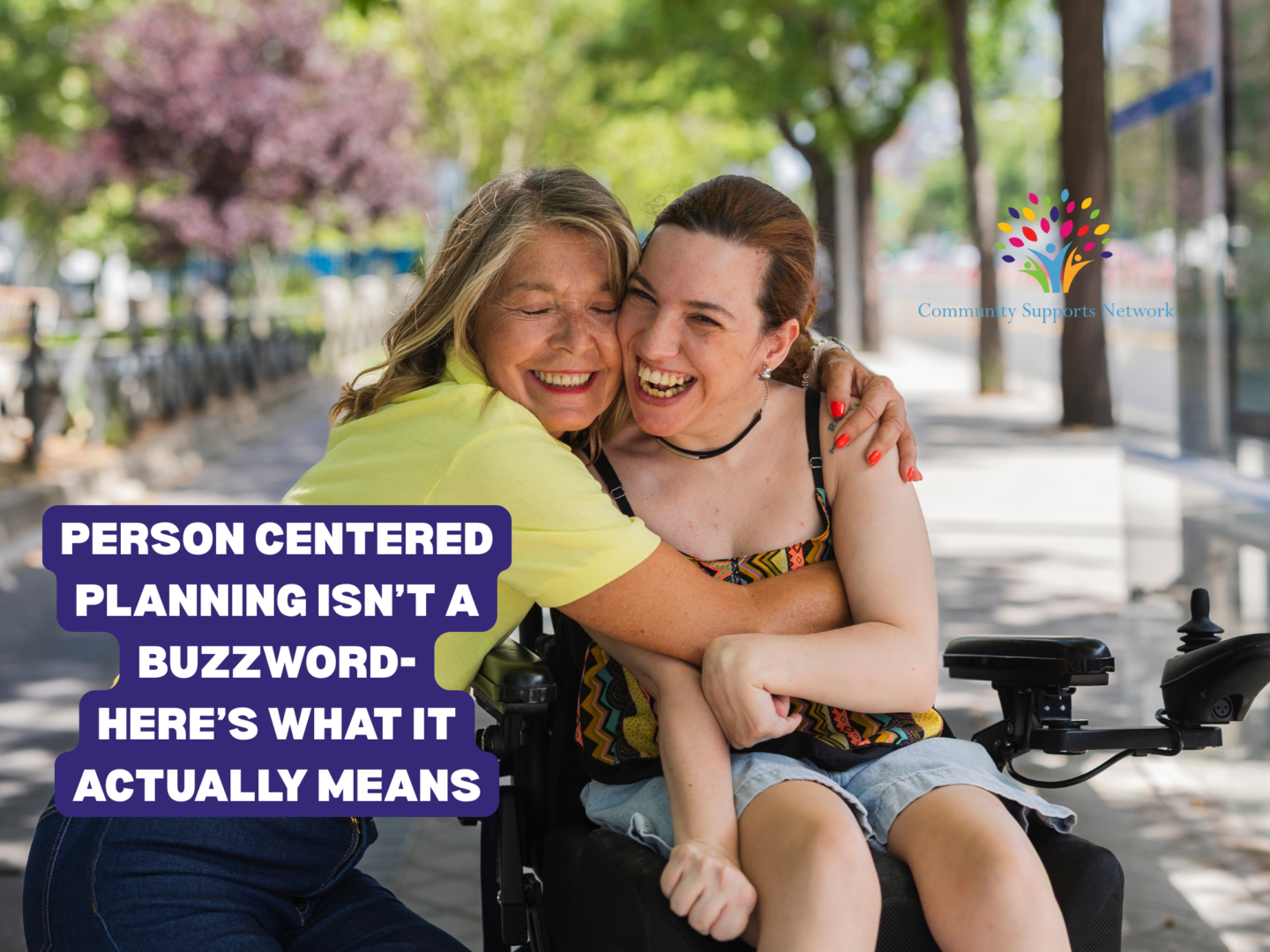
    Photo of a DSP joyfully hugging her client.  This moment embodies the essence of what person-centered planning really is all about.  It is far more than just making a list of planned activities.  It is how we show up together in support of one another.

    In the world of disability services, the phrase “person-centered planning” is everywhere.

    It appears in mission statements. It’s referenced in meetings. It shows up in documentation and training sessions.

    But what does it really mean?

    At Community Supports Network (CSN), person-centered planning isn’t a slogan. It’s the foundation of how we support individuals every single day.

    Person-centered planning means the individual is not just included in decisions — they lead them.

    It means support begins with listening.

    Not assumptions. Not checklists. Not systems.

    Listening.

    What Person-Centered Planning Is

    Person-centered planning is a collaborative process that focuses on an individual’s strengths, preferences, goals, and vision for their life.

    It asks:

    • What does a meaningful life look like to you?
    • What are your goals — big or small?
    • What environments help you thrive?
    • What kind of support feels respectful and empowering?

    Instead of designing services around what is available, person-centered planning designs services around what matters most to the individual.

    It recognizes that:

    • Independence looks different for everyone.
    • Growth is not one-size-fits-all.
    • Dignity is non-negotiable.

    The person is not a diagnosis. They are not a service plan. They are not a list of needs.

    They are a whole human being with preferences, dreams, relationships, and the right to direct their own life.

    What Person-Centered Planning Is Not

    It’s not completing paperwork and calling it a plan.

    It’s not deciding what’s “best” without meaningful input.

    It’s not focusing only on limitations.

    And it’s not creating goals based solely on what fits neatly into a program structure.

    True person-centered planning requires flexibility, creativity, and partnership. It sometimes requires slowing down. It requires humility. It requires trust.

    Most importantly, it requires believing that the person receiving services is the expert in their own life.

    What It Looks Like in Action

    Person-centered planning shows up in small, everyday moments.

    • It looks like honoring someone’s preferred communication style.
    • It looks like adjusting routines to match energy levels.
    • It looks like building employment goals around genuine interests — not convenience.
    • It looks like supporting friendships and community involvement that feel authentic, not forced.
    • It looks like asking before acting.
    • It looks like celebrating progress that matters to the individual — even if it’s invisible to others.

    At CSN, this philosophy guides how we approach supported employment, community-based services, and day-to-day support. Our role is not to control outcomes — it is to support individuals in building lives that feel meaningful to them.

    Why It Matters

    When planning is truly person-centered, outcomes improve.

    Confidence grows.

    Trust strengthens.

    Independence expands.

    Individuals feel seen — not managed.

    Families feel heard — not dismissed.

    Support professionals feel purposeful — not transactional.

    Person-centered planning isn’t about perfection. It’s about partnership.

    It’s about recognizing that every person deserves the opportunity to define success on their own terms.

    And it’s about building services that honor that right.

    At CSN, person-centered isn’t just what we say.

    It’s how we show up.

  • Breaking Down Barriers: How Disability Services Work in New Jersey (A Family Guide)

    Navigating supports in New Jersey can feel like alphabet soup—NJEIS, CSOC, DDD, HCBS, NJCAT. Here’s a clear, step-by-step map of who to call, when to apply, and what to expect—from birth through adulthood.


    Birth–Age 3: Early Intervention (NJEIS)

    If you’re concerned about a child’s development before age 3, start with the New Jersey Early Intervention System (NJEIS). It’s the statewide program (run by NJ Department of Health) that evaluates and provides services for infants and toddlers with delays or disabilities. Families can self-refer; services typically end at the child’s third birthday.

    For children 3 and older, referrals typically shift to the local school district; families can also use Project Child Find (800-322-8174).


    Up to Age 21: Children’s System of Care (CSOC) / PerformCare

    For youth with intellectual/developmental disabilities (I/DD), mental health needs, or substance-use challenges, New Jersey’s Children’s System of Care (CSOC) is the public front door.
    PerformCare is the 24/7 single point of access for eligibility and service coordination under CSOC:
    📞 1-877-652-7624
    🌐 www.performcarenj.org


    Planning the Transition to Adulthood (Around 18–21)

    You can apply to the Division of Developmental Disabilities (DDD) at age 18, but DDD’s adult services start at 21 (while school-based services can continue through 21). Families should begin transition planning with the school IEP team and explore DDD eligibility well before the 21st birthday so services can start smoothly.
    Learn more: DDD Eligibility


    Age 21+: Division of Developmental Disabilities (DDD)

    DDD administers New Jersey’s Home and Community-Based Services (HCBS) for adults with I/DD via two Medicaid waiver programs:

    • Supports Program (SP): for adults living with family or independently in the community.
    • Community Care Program (CCP): includes options for licensed residential settings with additional clinical criteria.
      📘 Supports Program Manual

    Key Requirements & Steps

    1. Medicaid eligibility
      You must have NJ FamilyCare Medicaid to receive ongoing DDD services.
      NJ FamilyCare Info
    2. NJCAT assessment
      DDD uses the New Jersey Comprehensive Assessment Tool (NJCAT) to measure support needs in self-care, behavioral, and medical areas.
      NJCAT Overview
    3. Budgets by tier
      Your NJCAT score determines your tier and annual budget in the Supports Program.
      Budget Tier Table – Effective Jan 1, 2024
    4. Choose a Support Coordination Agency (SCA)
      Once eligible/enrolled, adults select a Support Coordination Agency. Support Coordinators help develop the Individualized Service Plan (ISP), locate providers, and make changes as needs evolve.
      Search for SCAs and Providers

    Self-Directed Options

    New Jersey offers Self-Directed Employee (SDE) models where individuals can hire their own staff and purchase certain approved services.
    Two models are available:

    • Vendor Fiscal/Employer Agent (VF/EA)
    • Agency With Choice (AWC)

    As of 2025, DDD is transitioning the VF/EA fiscal intermediary from PPL to Acumen, with staggered rollout through September 2025. Your Support Coordinator will guide you through model selection and enrollment.
    Self-Direction Resources


    How CSN Fits In

    • Navigation & planning: We help families prepare for key handoffs—Early Intervention → CSOC/PerformCare → DDD—so services don’t lapse.
    • Support Coordination: Once an adult enrolls with DDD, we work with support coordinators to provide this service that matches their NJCAT-based budget.
    • Self-direction support: We assist with setting up and maintaining self-directed services for long-term success.

    Quick Contacts (New Jersey)


Serving Morris, Passaic, Bergen, Essex, Hudson, Union, Warren, Somerset, Hunterdon & Sussex Counties